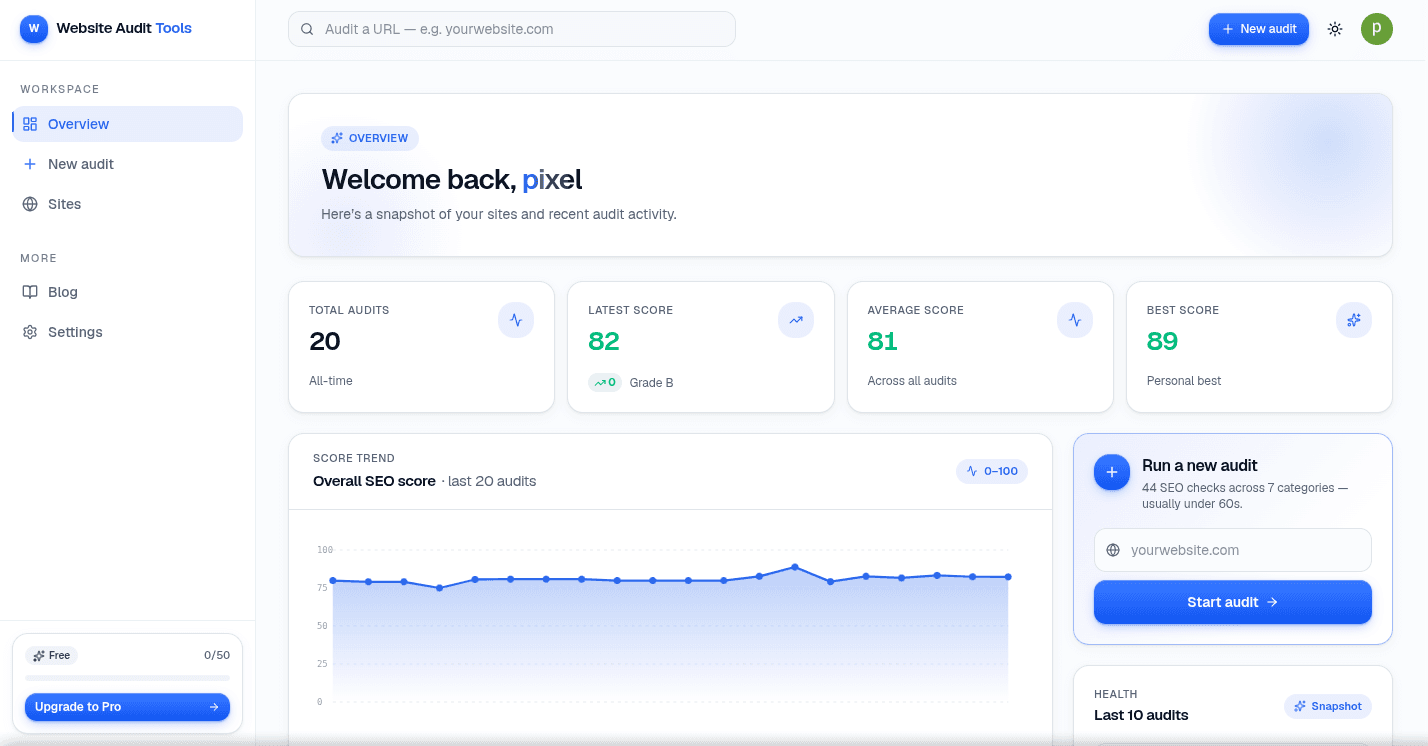
Every signal that moves rankings
100+ checks grouped into seven categories — surfaced as a single, prioritized action list. No 600-row spreadsheet.
On-page SEO
Title tags, meta descriptions, heading hierarchy and content quality — flagged by impact, not noise.
Technical health
HTTPS, canonicals, robots, sitemap and indexability checks across every URL we crawl.
Core Web Vitals
Real Lighthouse-grade LCP, INP and CLS measurements — not synthetic estimates.
Mobile experience
Viewport, tap target sizing, content fit and responsive breakpoints, judged the way Google does.
Schema & social
Open Graph, Twitter Card, JSON-LD types and rich-result eligibility, all parsed and validated.
Internal links
Anchor text, orphan pages, broken outbound links and PageRank distribution across the crawl.
From URL to a fix list in seconds
Three steps. No setup. No configuration. The same flow whether you're auditing your own site or a competitor.
What is a website audit?
A website audit is a full diagnostic of your site's SEO health. It systematically evaluates every factor that influences how search engines crawl, index, and rank your pages — from technical signals like page speed and canonical URLs to on-page elements like title tags, headings, and structured data.
Think of it as an MOT for your website. Just as a car service identifies failing parts before they cause a breakdown, a website audit surfaces SEO issues before they cost you rankings and traffic. A proper audit covers on-page SEO, technical infrastructure, mobile performance, and link profile.
According to Google Search Central, pages that satisfy E-E-A-T consistently outrank those that don't — and a website audit is the fastest way to identify where your E-E-A-T signals are weak.
Why run a free website audit?
Most websites have significant, fixable SEO issues they're unaware of. A free website audit gives you an objective, data-driven baseline — removing guesswork and showing you exactly where to focus your effort for maximum ranking gain.
Unlike manual reviews that take hours and miss issues, our automated audit runs 100+ checks in under 30 seconds and delivers a prioritised action list you can start working through immediately.
Find hidden technical errors
Broken canonicals, missing meta robots, and misconfigured redirects can silently tank your rankings. An audit surfaces these instantly.
Prioritise fixes by impact
Our report ranks findings by severity so you spend time on changes that actually move the needle.
Benchmark against competitors
Run an audit on any competing site to see which SEO best practices they follow — and where you can overtake them.
Track improvements over time
Re-audit after implementing fixes to confirm your score is climbing and no regressions have appeared.
100+ SEO checks we run on every audit
Every website audit runs more than 100 individual checks across four core domains. Here's a breakdown of what we analyse on every report.
Learn more about Core Web Vitals on web.dev and structured data on Schema.org.
+ checks
run on every website audit
On-page SEO audit — title, meta, headings, content
On-page SEO is the foundation of any website audit. It covers everything visible in your HTML that communicates relevance to search engines: your title tag, meta description, heading hierarchy, body copy, and image alt attributes.
A well-optimised title tag should be 50–60 characters, front-load the primary keyword, and match the search intent of your target query. Our website audit flags tags that are too short, too long, duplicated across pages, or missing keywords entirely.
For a deep dive into what Google expects, see Google's Search Quality Rater Guidelines.
Technical SEO audit — Core Web Vitals, crawlability, indexation
Technical SEO problems are often invisible to the naked eye but devastating to rankings. Our website audit checks the full technical layer of your page — from server response codes and HTTPS configuration to canonical URLs, robots directives, and Core Web Vitals signals.
Core Web Vitals — LCP, INP, and CLS — are confirmed Google ranking signals. Pages scoring Good on all three consistently outrank pages in the Needs Improvement or Poor range.
A misconfigured robots.txt or accidental noindex directive can silently remove pages from search results — our audit catches these immediately.
Mobile-friendliness audit
Google uses mobile-first indexing for all sites — meaning it crawls and indexes the mobile version of your page as the primary version. If your mobile experience is broken, your rankings suffer everywhere, including desktop.
Our mobile-friendliness audit verifies your viewport meta tag is correctly set, text is legible without zooming, touch targets are adequately sized (≥ 48×48px), and content does not overflow the screen width.
With over 60% of global web traffic now coming from mobile devices, a mobile-friendly website is non-negotiable for SEO in 2026.
Backlink and authority audit
Links from authoritative external sites remain one of the strongest ranking signals in Google's algorithm. Our website audit examines your outbound link structure — internal link counts, external link ratios, and whether your links point to authoritative sources.
For a full backlink profile including referring domains and toxic link detection, upgrade to our Pro plan. The free website audit covers your on-page link structure and identifies broken outbound links leaking authority.
Building a strong internal link structure is something you can start immediately after your audit — a quick win that improves crawlability and distributes PageRank more effectively.
Local SEO audit
For businesses serving a specific geographic area, local SEO is the highest-ROI channel available. Our website audit checks the on-page local SEO signals that Google evaluates for map pack rankings: NAP consistency, LocalBusiness schema markup, hreflang, and location-specific content signals.
We verify that your LocalBusiness JSON-LD schema is correctly implemented — a quick win that can dramatically improve your visibility in "near me" searches and local recommendations.
Pro users can connect their Google Business Profile to cross-reference on-site signals with their GBP listing and receive unified local SEO recommendations from a single dashboard.
Website audit tool vs Seoptimer / Semrush / SE Ranking
Not all website audit tools are equal. Here's how WebsiteAuditTools compares to the most popular alternatives on the factors that matter most for getting actionable results fast:
| Tool | Free tier | Speed | No signup |
|---|---|---|---|
| WebsiteAuditToolsYou are here | 100+ checks | < 30s | ✓ |
| Seoptimer | Limited | ~60s | ✓ |
| Semrush | Trial only | Minutes | ✗ |
| SE Ranking | Trial only | Minutes | ✗ |
Unlike enterprise tools that lock core features behind expensive subscriptions, our free website audit gives you the same depth with no account required. See a sample audit report →
White-label SEO audit reports
Running an SEO agency or freelance consultancy? Our white-label website audit tool lets you deliver branded PDF reports to clients under your own logo and domain — with zero mention of WebsiteAuditTools.
White-label reports are fully customisable: add your agency name, logo, brand colours, and a personalised executive summary. Deliver professional audit reports in minutes rather than hours.
Available on the Pro plan. You can also embed a website audit widget on your agency's site to capture leads — every visitor who runs an audit becomes a potential client. Learn about white-label audits →
Frequently asked questions
Everything you need to know about running a free website audit. If something's not covered here, email hello@websiteaudittools.com.
What is a website audit?
How do I run a free website audit?
What does the website audit tool check?
Is this really free?
How long does the website audit take?
What is an SEO score and how is it calculated?
How often should I audit my website?
Can I audit a competitor's website?
How do I fix the issues found in my audit?
Ready when you are.
Create your free account and start improving your site in minutes. 100+ checks, impact-ranked fixes, a downloadable report.
Get started →